Few places on earth hit your senses quite like Morocco. One minute you are dodging speeding mopeds and donkey carts in an alleyway barely wide enough for your shoulders. A day later, you are sitting atop a mountain of glowing orange sand, wrapped in wool under a silent, star-scattered sky.
If you are planning a trip, you are certainly not alone. Morocco welcomed a record 19.8 million visitors in 2025¹, quickly turning the country into one of the world's most sought-after travel spots. With massive infrastructure upgrades underway ahead of co-hosting the 2030 FIFA World Cup, getting around has never been smoother.
Pairing the ancient Imperial cities with the raw expanses of the Sahara gives you the ultimate contrast. It is a route that swaps relentless urban rhythm for complete desert silence. Here is how to tackle this classic adventure with confidence.
Understanding the Labyrinthine Medinas of Marrakech and Fes
Morocco's Imperial cities are anchored by two legendary urban centers: Marrakech and Fes. Although both hold centuries of dynastic history, they have completely different personalities.
Marrakech is dynamic, sensory, and cinematic. The walled medina radiates out from Jemaa el-Fna, the sprawling central square filled with musicians, storytellers, and juice vendors. The narrow residential alleys, known as derbs, are packed with energy. You will constantly share the pavement with mopeds, bicycle couriers, and fellow travelers. Keep to your right, download an offline map on your phone before entering covered alleys, and do not sweat getting turned around.
Fes, on the other hand, is an entirely preserved medieval world. Founded in 789 AD, the historic district of Fes el-Bali contains over 9,000 alleys and more than 350 mosques. It is recognized as the world's largest car-free urban zone, meaning goods still move exclusively on pushcarts and mules. When you hear someone shout "Balak!", move aside quickly to let a pack animal pass.
• Hiring a Local Guide: In Marrakech, self-navigation is straightforward once you find your bearings. In Fes, book a certified local guide for your first morning so you can find hidden artisan quarters without hitting dead ends.
• Visiting Historic Monuments: Make time for Medersa Ben Youssef in Marrakech to admire its intricate stucco carving, and stop by the University of Al-Quaraouiyine in Fes, which was founded in 859 AD.
• Tannery Street Smarts: When visiting the 11th-century Chouara Tannery in Fes, shopkeepers will hand you a sprig of fresh mint. Keep it close to your nose. The natural pigeon dung and limestone vats used to cure leather create a powerful odor.
• Handling Street Touts: If someone tells you a street is closed for prayer or renovation, take it with a grain of salt. Politely offer a firm "La, Shukran" (no, thank you) and keep walking toward your destination.
A Sensory Feast of Souks and Local Cuisine
Moroccan markets are a theater of color and commerce. Hand-carved cedar, brass lanterns, leather slippers, and woven rugs line the tiny stalls. Haggling is simply standard conversation here, not an argument. Shopkeepers expect counteroffers, so offer around a third of the opening price and negotiate pleasantly from there. If you cannot reach a fair deal, thank them and walk away. That alone often reveals the true bottom price.
When your feet give out, the food scene provides immediate relief. Although tagines and skewers are everywhere, regional specialties are where Moroccan cooking shines.
In Marrakech, track down Tangia Marrakchia. Historically assembled by working bachelors on their days off, this rich stew combines beef or lamb with garlic, cumin, saffron, preserved lemons, and aged butter. The ingredients are sealed inside an earthen clay urn and dropped into the underground wood ashes that heat the neighborhood hammam. After simmering for hours, the meat falls apart at the touch of a fork.
In Fes, order a proper Pastilla. This aristocratic pastry layers shredded poultry, toasted almonds, sugar, and warm cinnamon inside paper-thin sheets of crisp dough. It delivers an unforgettable mix of sweet and savory in every bite.
When you reach the desert fringes, look for Medfouna, often called "Berber pizza." Originating in the oasis towns near Erg Chebbi, this flatbread is stuffed with spiced ground beef or lamb, onions, almonds, and hard-boiled eggs before baking inside traditional clay ovens.
The Call of the Sahara and Desert Camping Adventures
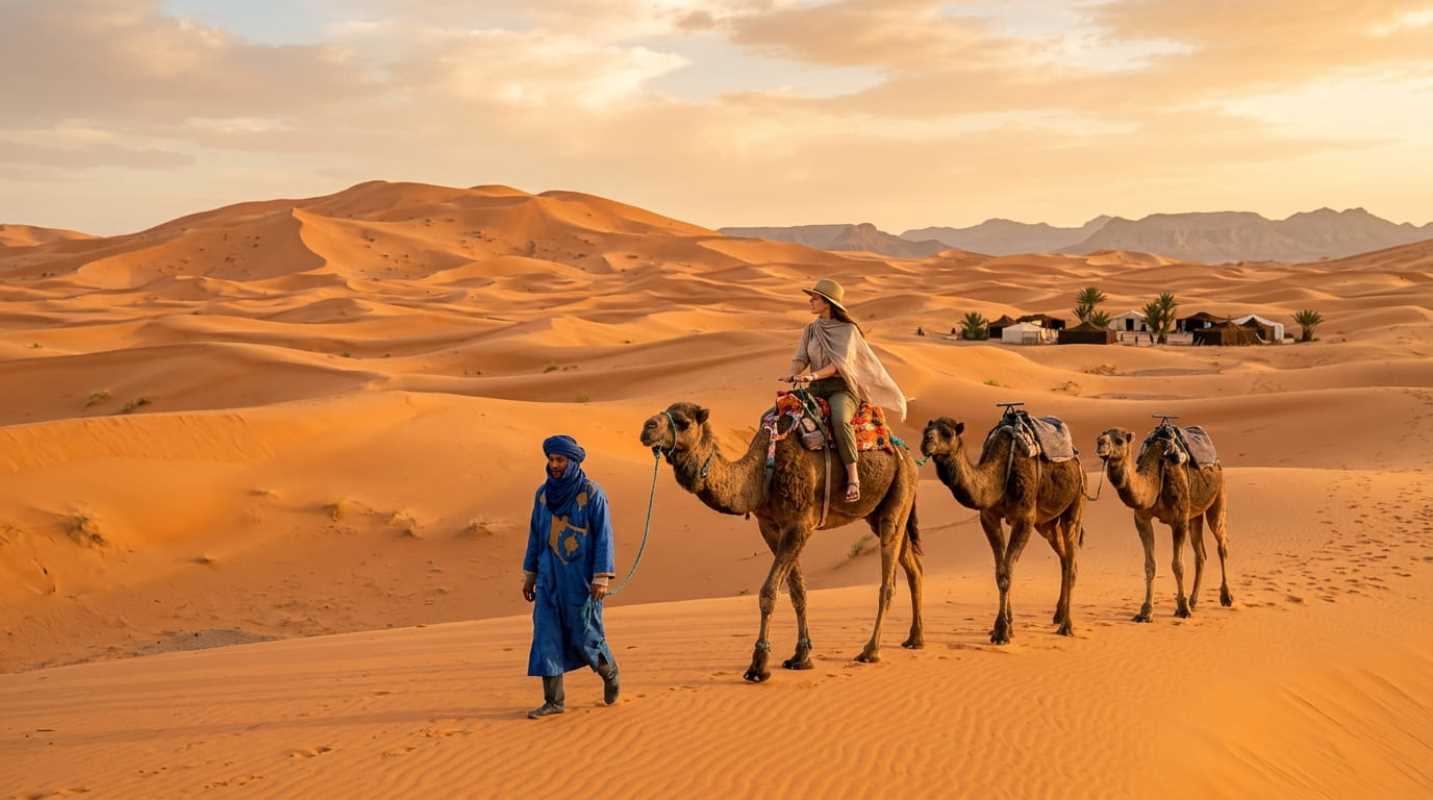
Leaving the cities behind to head south across the Atlas Mountains brings a dramatic change of scenery. The stone plateaus slowly give way to the Sahara, where towering dunes replace clay walls.
Most travelers choose between two main dune fields: Erg Chebbi and Erg Chigaga.
• Erg Chebbi (Merzouga): These dunes rise up to 150 meters and feature glowing orange sand. Merzouga is accessible by paved roads, making it ideal if you are on a tighter schedule. Camps sit just a short 4x4 ride or camel trek from town.
• Erg Chigaga (M'Hamid): For true isolation, head here. Reaching these wilder dunes requires two or more hours of off-road driving across rocky plains. The reward is complete silence, towering ridge crests, and zero light pollution.
Overnight stays in the dunes have evolved well beyond basic wool bivouacs. Modern eco-camps run on silent solar panels rather than noisy diesel generators, offering hot-water showers, flush toilets, and king-size beds.
Evenings in the Sahara revolve around classic Berber hospitality. You will share fresh tagines, sip sweet mint tea around a glowing campfire, and listen to traditional drum rhythms echoing across the sand. Bring warm layers if you visit between November and February. Once the sun dips behind the dunes, desert temperatures drop to near freezing.
Practical Tips for Your Moroccan Journey
Planning logistics carefully makes the difference between a relaxing adventure and a stressful marathon.
• Best Travel Windows: Spring (March to May) and autumn (September to November) provide ideal temperatures for both city walking and desert nights. Summer brings extreme heat, with desert temperatures regularly topping 45°C (113°F).
• High-Speed Rail Upgrades: The Al Boraq high-speed train network is expanding from Kenitra down to Marrakech ahead of the 2030 World Cup, which will cut long transit times between northern ports and the Red City down to under three hours.²
• Cash Is King: Although boutique riads and desert tour operators readily take credit cards, daily medina life runs entirely on cash. Keep a stash of Moroccan Dirhams (MAD) for snacks, market shopping, and small tips.³
• Dress Thoughtfully: Morocco is a traditional Muslim country. Loose-fitting clothing that covers your shoulders and knees shows respect and keeps you comfortable in midday heat.
Why Morocco Stays With You
Morocco hits every chord. It is the clash of copper hammers echoing out of Place Seffarine in Fes, the aroma of cumin drifting from a corner food stall, and the cool sand beneath your boots at dawn in the Sahara.
The country rewards curious travelers who lean into the chaos rather than resist it. Accept that you will get lost in the alleys, drink more mint tea than you ever imagined, and leave with sand lingering in your luggage. Pack an open mind and a sturdy pair of shoes: Morocco is ready to welcome you.
Sources:
1. Morocco Posts Record 19.8M Tourist Arrivals in 2025
https://atta.travel/resource/morocco-posts-record-19-8m-tourist-arrivals-in-2025.html
2. Morocco 2030 High-Speed Rail
https://moroccomag.com/morocco-2030/high-speed-rail/
3. Morocco Tourism Statistics
https://guideme.ma/morocco-tourism-statistics/