Have you ever spent forty-five minutes scrolling through Netflix, Disney+, or Prime Video, only to give up and stare at your phone instead? Have you watched your monthly subscription costs creep past the price of an old cable package, while the shows you love vanish without warning?
You are definitely not alone. A few years ago, the tech world promised that physical discs and records were headed for the trash heap of history. Digital streaming was supposed to give us everything ever recorded for the cost of a couple of coffees each month.
Instead, streaming fatigue has fully set in. Between price hikes, intrusive ad tiers, and licensing disputes that pull beloved movies from servers overnight, millions of people are feeling burned out. An Octane Seating survey found that only 11 percent of Americans regularly finish what they start watching on streaming platforms. We are swimming in an ocean of content, yet we end up dissatisfied.
That digital overload has triggered a massive consumer backlash. People are returning to physical objects because holding an album or sliding a disc into a player offers a sensory and psychological reward that an app icon can never replicate.¹
The Tangible Connection for Collectors
Why are we buying physical objects in 2026 when almost any song or film lives on a remote server? The answer comes down to psychology and human connection. When you stream a track on Spotify, you do not own anything. You rent a temporary license that can expire whenever a contract changes.
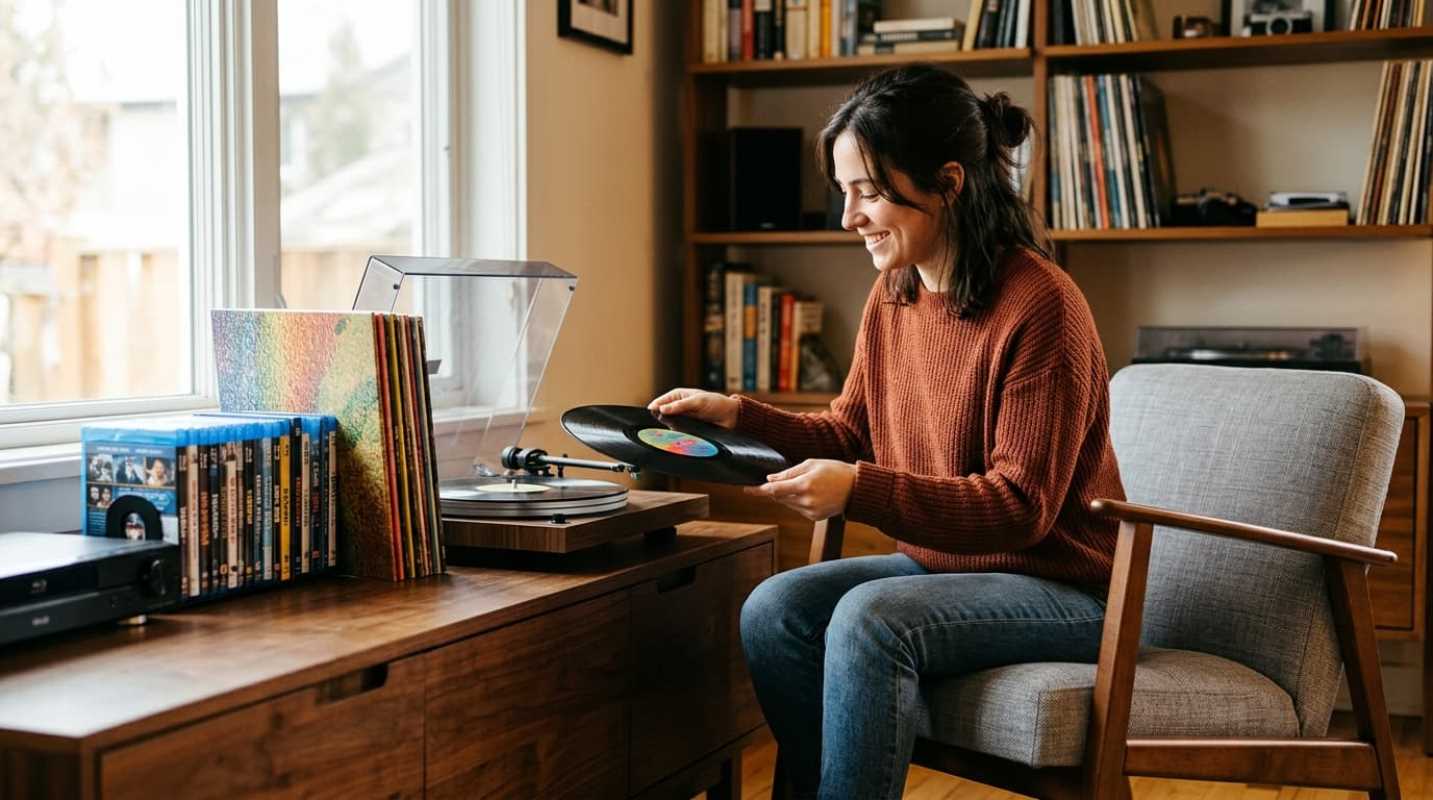
When you pull a heavy 180-gram vinyl record from its gatefold jacket, place it on a turntable, and gently drop the needle into the groove, you create an intentional ritual. You are choosing to spend time with art rather than treating it like disposable wallpaper.
Younger listeners are driving this shift. Industry research from Luminate reveals that over 40 percent of physical media buyers are under 35. Rather than living purely through screens, Gen Z and Millennials want curated shelf displays that reflect their personality.
Think of your media collection as an archive of your identity. A customized shelf lined with colorful vinyl spines, boutique 4K cases, and collectible SteelBooks tells visitors who you are within five seconds. You cannot display an algorithmic recommendation feed on your living room wall. Physical media turns art back into a conversation piece.
Sound and Picture Quality Beyond the Stream
Marketing departments have spent years convincing us that digital streaming matches disc quality. You see the little "4K HDR" and "Dolby Atmos" badges next to a movie title and assume you are getting theater-grade fidelity.
That assumption is flat wrong. Streaming services prioritize bandwidth efficiency over raw presentation. To deliver video smoothly to millions of households without buffering, platforms compress video and audio down to tiny file sizes.
When you look beneath the hood, the technical divide between streaming and physical media is huge
• Bitrate performance: A standard 4K stream on Netflix or Prime Video usually peaks at a compressed bitrate between 15 and 25 Mbps. By contrast, a 4K Ultra HD Blu-ray disc streams data locally at 50 to 100+ Mbps.²
• Visual clarity: That massive bitrate advantage eliminates ugly compression artifacts, color banding, and macroblocking in dark scenes, which is needed for shadow-heavy films like The Batman or Oppenheimer.
• Uncompressed audio: Streaming services rely on lossy Dolby Digital Plus audio. Discs output full, uncompressed tracks like Dolby TrueHD and DTS-HD Master Audio, providing bone-rattling dynamic punch and dialogue clarity that soundbars and surround systems crave.
• Analog sound signature: Turntable setups deliver an organic, acoustic warmth that clinical digital files simply do not reproduce.
The Economics of Ownership in an Era of Delisting
Beyond visual and acoustic superiority, buying physical media has become a necessary defense against corporate whims. Over the past three years, Hollywood studios started treating completed art like corporate accounting write-offs.
Warner Bros. Discovery shocked the entertainment industry by shelving finished movies like Batgirl and purging prestige series like Westworld from digital platforms to cut royalty payments. Disney pulled dozens of exclusive series and films from Disney+ within months of their release. If you loved those titles and did not own a disc, they effectively became lost media.
Even paying to "buy" a movie on Amazon or Apple does not grant you genuine ownership. You are simply purchasing a revocable viewing license. When licensing agreements shift between distributors, titles can quietly disappear from your digital library without a refund.
Filmmaker Christopher Nolan highlighted this issue during the physical home release of Oppenheimer. He pointed out that when you purchase a 4K UHD or a Blu-ray disc, it sits on your shelf. No corporation can reach into your home, change the terms of service, and repossess it.
That realization has turned physical media into a resilient, high-value market. In 2025, U.S. vinyl wholesale revenues officially passed $1.04 billion across 46.8 million new units sold.³ At the same time, 4K Blu-ray sales jumped 12 percent year-over-year. Limited-edition packaging from boutique publishers like the Criterion Collection, Arrow Video, and Vinegar Syndrome now sells out within hours, with copies regularly appreciating on the secondary market. Physical ownership protects your wallet against recurring rental fees and protects your favorite culture from deletion.
The Future of Media Consumption
Does this physical revival mean that streaming is dying? Not at all. Streaming is undeniably convenient when you are commuting on a subway, working out at the gym, or sampling a new artist you have never heard before.
What we are witnessing is a permanent rebalancing of how culture is consumed. People are tired of digital impermanence. We are moving toward a model where convenience is rented, but the art that truly matters to you is owned.
Placing a record on a platter or popping a 4K disc into a tray requires intention. It asks you to slow down, put away your phone, and actually engage with human creativity. In an age dominated by fleeting digital noise, having something real to hold onto is worth every penny.
Sources:
1. Physical Media Revival Grows as Streaming Fatigue Drives Listeners Back to CDs and Vinyl
https://news.lavx.hu/article/physical-media-revival-grows-as-streaming-fatigue-drives-listeners-back-to-cds-and-vinyl
2. Physical Media Market Report 2025
https://www.digiraw.com/films-and-shows/insights-and-analysis/physical-media-market-report-2025/
3. RIAA 2025 Year-End Revenue Report
https://www.riaa.com/wp-content/uploads/2026/03/RIAA-Year-End-Revenue-2025.pdf