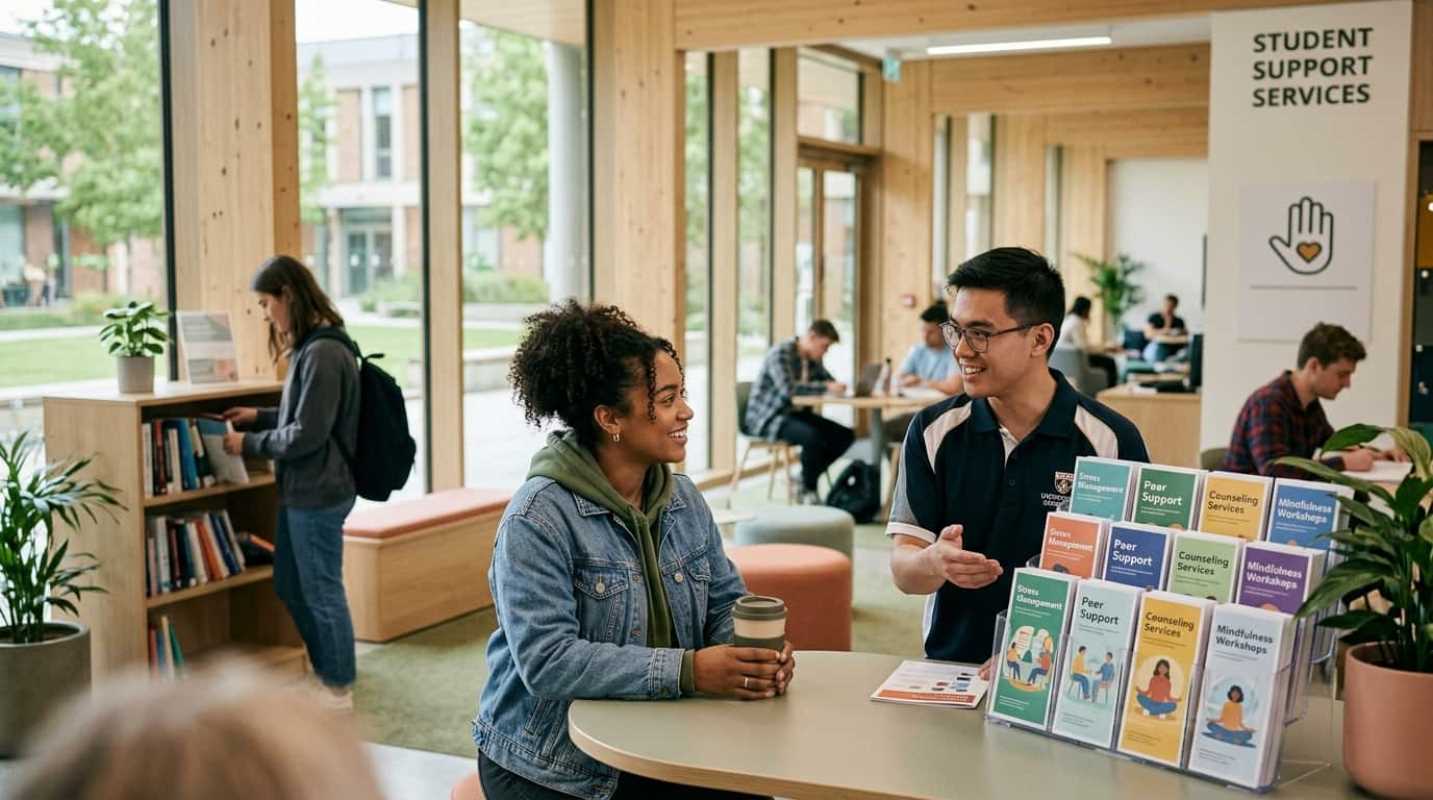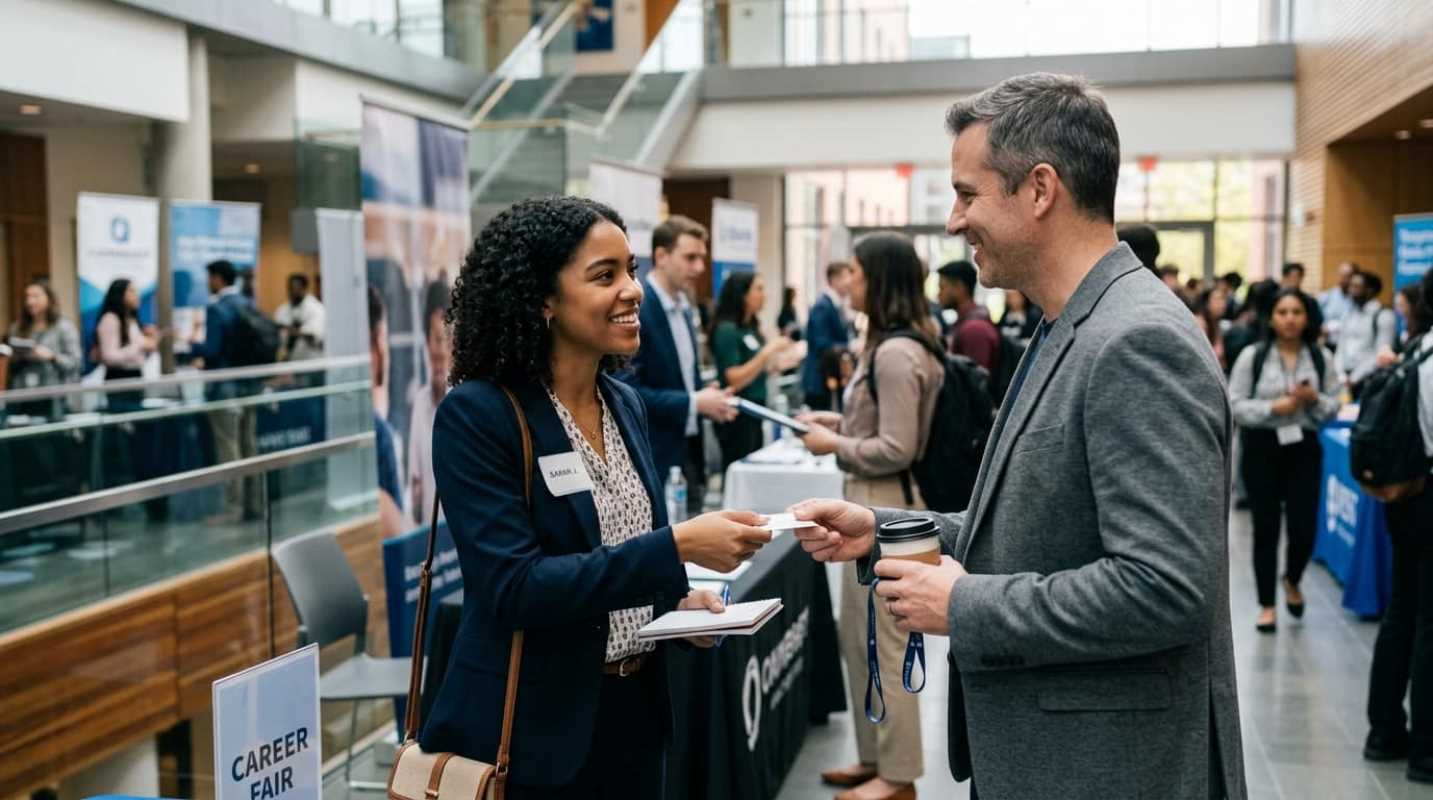
Have you ever walked into a room full of strangers in business casual and immediately wanted to turn around? You are not alone. A survey by the organization The 93% Club found that 82% of working-class students feel intimidated at employer networking events, and 56% leave early because they feel overwhelmed by unfamiliar social expectations. It is a completely natural reaction. Walking up to established professionals and trying to sell yourself feels awkward, unnatural, and highly stressful.
But here is the reality check. Networking is the actual backdoor to the job market. According to Erica LaRue, Director of Career Services at WVU, 80% of job opportunities are secured through social and professional networks rather than traditional job boards.¹ Think of it like getting a recommendation for a great restaurant. You trust a friend's review more than a random flyer. Hiring managers operate the exact same way.
In fact, 54% of U.S. workers were hired through a personal connection.² Plus, 84% of job seekers believe networking is needed to get a foot in the door, and 92% of hiring managers agree.³ Stop viewing networking as a transactional game of collecting business cards. Focus instead on building genuine relationships long before you actually need them.
Why Networking Is Not Just for Corporate Veterans
When you are in college, it is easy to put networking on the back burner. You might think it is only for seniors hunting for a job or business majors practicing their handshakes.
In reality, the connections you make today form the foundation of your entire career. Your professional circle is not just a list of people who can give you a job. It is a group of mentors, advisors, and peers who can help you handle industry shifts, offer advice on difficult work situations, and introduce you to new ideas.
Building this circle early gives you a massive advantage. By the time you graduate, you will already have a reputation and a list of people who can vouch for your character and work ethic.
The trick is to start before you need anything. When you reach out to someone when you are desperate for a job, it feels transactional. When you reach out because you are genuinely curious about their career path, it builds a lasting connection.
Mastering LinkedIn Presence Building
If networking is the game, LinkedIn is your home court. Kelsey Shultz, a Career Education Manager at Colorado State University, points out that LinkedIn is really for building a community, not just job searching.
Recruiters use the platform like a search engine. In fact, 87% of recruiters use LinkedIn to vet candidates. Students with optimized profiles get 21 times more profile views and 36 times more recruiter messages than those with basic profiles.
How do you build a profile when you do not have years of corporate experience? You focus on your potential.
• The Profile Photo - Having a professional, high-quality photo makes your profile 14 times more likely to be viewed. Use a tight crop of your head and shoulders with good lighting and a clean background.
• The Banner - Do not leave the default grey background. Use Canva to make a simple graphic featuring your school colors, a clean graphic representing your major, or a quote that inspires you.
• The Headline - Move past the standard "Student at X University" formula. Your headline follows you everywhere you comment or connect. Use one of these formulas to stand out:
• Formula 1 (The Aspiring Professional) - Aspiring [Target Role] | [Major] Student at [University] | Skilled in [Skill 1], [Skill 2]
• Formula 2 (The Action-Oriented Student) - [Major] Student | Exploring [Field/Niche] | Building [Project/Skill]
• The About Section - Write in the first person and tell a story. Use your first paragraph to explain what sparked your interest in your major. Use the second to highlight your coursework, club leadership, or personal projects. Use the third to state your goal, such as finding a Summer 2026 internship.
• Experience and Engagement - If you lack formal internships, treat your coursework as experience. List major academic projects and quantify your achievements, like leading a team of four to analyze a large dataset.
Aim to get at least 50 connections quickly. Connect with classmates, professors, and family friends to build baseline credibility on the platform.
Effective Alumni Outreach Tactics That Actually Work
The single most valuable asset you have as a student is your university affiliation. Alumni feel a natural urge to pay it forward to students from their alma mater.
When reaching out to alumni, focus on requesting an informational interview rather than asking for a job. Asking for a job outright is the quickest way to get ignored. An informational interview is a short, low-pressure conversation where you ask for advice and career insights.
Keep your outreach messages short, specific, and easy to answer. Giving them an easy way to decline actually makes them more likely to reply because it removes the pressure.
Here is a template you can use when reaching out to an alum who graduated with your major:
Subject: Fellow [University Name] grad – quick question about [Industry/Field]
Dear [Alum's Last Name],
My name is [Your Name], and I am currently a junior studying [Your Major] at [University Name].
I came across your profile on LinkedIn while researching career paths in [Industry]. I was incredibly impressed by your transition from [University Name] to your current role as a [Alum's Job Title] at [Company Name].
I am hoping to follow a similar path and would love to learn more about your day-to-day work and any advice you might have for a student entering the field.
Do you have 15 to 20 minutes for a brief phone or Zoom call sometime in the next few weeks? I know you are busy, so I am happy to work entirely around your schedule. If you don't have the bandwidth right now, I completely understand.
Thank you for your time and consideration,
[Your Name]
[Your Phone Number] | [Your LinkedIn Profile Link]
If you are targeting a specific company, use this variation:
Subject: [University Name] student seeking career advice on [Company Name]
Dear [Alum's Name],
I hope you’re having a great week. My name is [Your Name], and I am a senior at [University Name] majoring in [Your Major].
I am highly interested in [Company Name] because of your recent work in [mention a project or company value]. I noticed you’ve been with the company for [Number] years, and I would love to hear your perspective on the company culture and how you handled your early career after graduating from [University Name].
Would you be open to a quick 15-minute virtual coffee chat to share your insights?
I appreciate you considering this request!
Best regards,
[Your Name]
[Your LinkedIn Profile Link]
Professional Event Etiquette and Navigating Rooms Like a Pro
Although digital networking is highly effective, physical and hybrid events still hold massive value. When you attend campus events, guest lectures, or career fairs, you need a simple, human elevator pitch.
Forget the rehearsed, robotic sales pitches. Use a conversational 30-second formula.
• Who you are - "I'm a junior at [University] studying [Major]."
• What you are focused on - "Right now, I'm really focused on learning how [specific industry trend] is changing the market."
• Where you are going - "My goal is to land an internship where I can apply my skills in [Skill] to help solve [Problem]."
When you are at these events, practice the 5-minute rule. Do not just run out the door when a presentation ends. Stay behind for five minutes to shake the speaker's hand, mention a specific point they made, and ask for their LinkedIn.
Remember to use active listening. Focus on what the other person is saying rather than planning your next line.
Finally, master the 48-hour follow-up rule. Send a personalized LinkedIn connection request within 48 hours of meeting anyone. Mention a specific topic you discussed to cement the connection.
Building Authenticity in a Digital World
Authenticity is your secret weapon. People can spot a fake or rehearsed script from a mile away. It is always better to be yourself, even if you feel a bit inexperienced.
Avoid the "ghost and ask" method. Do reach out to your network when you need a favor, like a job referral.
Maintain your connections by sending quick updates every few months. Share an interesting article, congratulate them on a promotion, or send a quick note letting them know how their advice helped you.
Networking is a two-way street. Think about how you can help your peers, share resources, or support classmates. Your peers today are your professional network tomorrow. Treat group projects as professional trial runs.
Start Small and Think Big
Building a professional network does not happen overnight. It is a slow, steady practice of making small connections that compound over time.
As you head into the upcoming semester, set a simple goal. Aim to make just one new connection a week.
View every interaction as a learning opportunity, whether it is a quick chat with a professor after class or a brief message to an alum.
The best time to start building your network is before you actually need it. Go ahead, open LinkedIn, and send your first connection request today.
Sources
1. Remote Networking Tips and Tricks
https://online.wvu.edu/news-and-stories/2025/05/26/remote-networking-tips-and-tricks
2. Networking Statistics
https://wavecnct.com/blogs/networking-statistics
3. 84 Percent of U.S. Job Seekers Say Networking Matters
https://www.expresspros.com/newsroom/news-releases/news-releases/2026/03/84-percent-of-us-job-seekers-say-networking-matters-but-59-percent-don-t-know-where-to-begin